Vehicle sales from enquiry to delivery
How the Automotive pack follows a vehicle sale through its stages from enquiry to delivery, records lost deals with a reason, and what stays outside it.
By Achekam · · 4 min read · For Automotive businesses in South Africa, Nigeria, Kenya
Launching soon. The Industry CRM add-on described in this article is launching soon. This article describes it as it will work at launch.
Every dealership has a version of the same Monday meeting. The sales manager goes round the room asking about deals. One salesperson's "hot prospect" turns out to be someone who took a brochure three weeks ago. Another has a buyer waiting on finance but cannot say since when. A third lost a deal on Saturday and nobody knows why. At the end, the dealer principal still cannot say how many cars will deliver this month.
A sales pipeline replaces that meeting's guesswork with records. The Automotive pack in Achekam's Industry CRM follows each vehicle sale from the first enquiry to the day the customer drives away, using stages every salesperson recognises. This article explains those stages, what happens to deals that are lost, and what the pack deliberately leaves to other people and systems.
Three kinds of record for a dealership
The Automotive pack is built for vehicle dealerships, and it keeps three kinds of record:
- Vehicle sales, which can include trade-ins;
- Service jobs, the workshop's work, with parts and labour; and
- Test drives.
The words on the screens, the stages, the workflows and the documents to request and sign are all set by the pack, so salespeople work in their own language rather than a generic "opportunity" screen. This article is about vehicle sales; the workshop side is covered in workshop job cards signed electronically.
Test drives deserve their own records. A paper diary at reception rarely says who drove which vehicle, when, and what they thought of it afterwards; a record per test drive does, and it gives the salesperson something concrete to follow up on.
A sale often begins as a lead, from a website enquiry, a walk-in or a phone call. Converting the lead creates the customer and the vehicle sale at once and starts the sale's workflow, so the salesperson does not retype the customer's details.
The stages of a vehicle sale
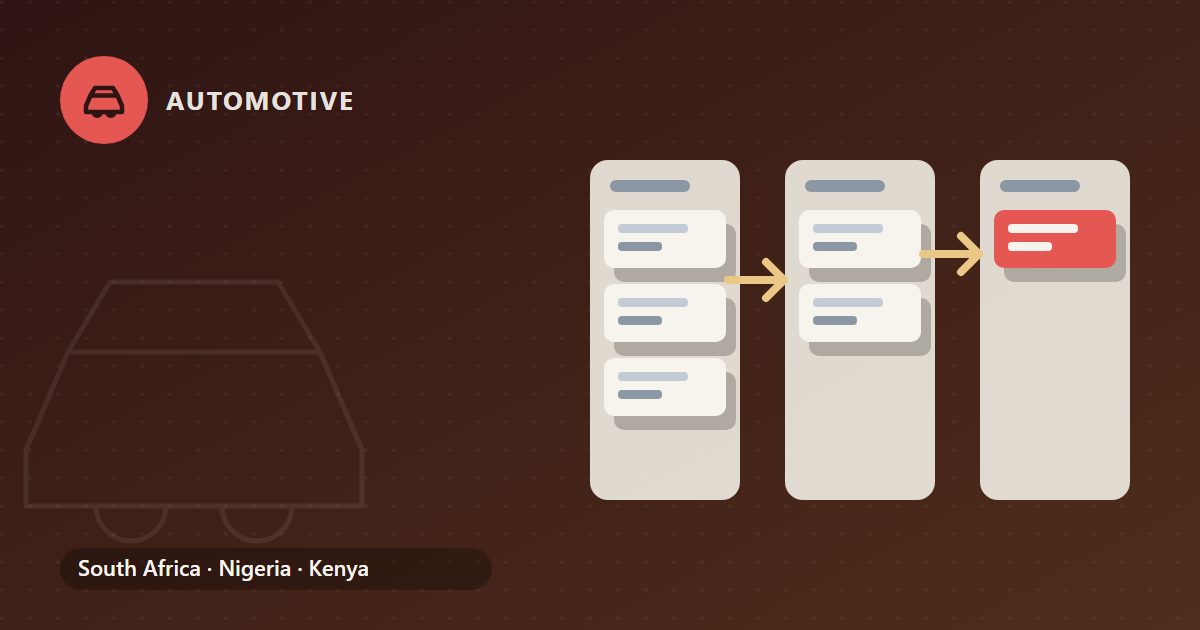
Each vehicle sale moves through six stages, or leaves the pipeline as lost:
| Stage | What it means on the floor |
|---|---|
| Enquiry | Someone has asked about a vehicle or a model |
| Test drive and needs | The customer has driven the car, and their needs and budget are understood |
| Deal on the table | A specific vehicle, price and terms have been put to the customer |
| Finance applied for | The customer's finance application has been submitted |
| Offer signed | The customer has signed the offer to purchase |
| Delivered | The vehicle has been handed over |
| Lost | The deal did not happen, and the reason is recorded |
The stages describe facts, not feelings. A deal is "on the table" when a specific offer exists, not when the salesperson feels good about it. That is what makes the pipeline useful in Monday's meeting.
If the customer is trading in a vehicle, the appraisal and its approval travel with the sale; see trade-ins: appraisal and manager approval.
Lost, with a reason
A sale that does not go ahead is marked Lost with a reason. That rule is easy to resent and very valuable to keep. A pipeline that only records wins tells you nothing about why customers walk away.
Agree a short list of reasons with your sales team, for example:
- price or deal terms;
- finance declined;
- trade-in value not accepted;
- vehicle not available in time;
- bought elsewhere;
- customer stopped responding.
Review the lost reasons monthly. If many deals are lost at finance, the conversation is with the finance office and the banks. If many are lost on trade-in value, it is with the used-vehicle manager. Neither conversation can happen without the reasons.
Conditions on moving a deal forward
In the Industry CRM, a record cannot move into some pipeline stages until set conditions are met, such as a customer being named, an amount being set or a signature being done. Conditions like these stop a sale running ahead of the facts. A stage that requires a signature, for example, cannot be reached until the signature task is done.
Check which conditions your pack's stages carry and explain them to the sales team, so that a stage refusing to move is understood as a missing step, not a fault.
What stays outside the pack
The Automotive pack follows the sale. It does not do three things that belong to other people and systems:
- It applies for no finance. "Finance applied for" records that the application was submitted by your finance and insurance staff through the banks' own channels.
- It runs no credit check. Credit decisions are the lenders' and your finance office's.
- It does not register or license vehicles. Vehicle registration and licensing are done by a person outside the pack.
Being clear about this avoids a common misunderstanding: the pipeline shows where a deal stands, but it is not the system that approves or registers anything.
Reading the pipeline
The pack's home page shows counts drawn from the records, the tasks or the ledger, never typed in by hand. For a sales manager, the useful ones include records in each stage, pipeline value, deals won this month and revenue this month. "How many cars will deliver this month?" starts with a look at how many sales have reached Offer signed, rather than a round of the room. Investopedia's guide to customer relationship management sets out the sales, service and forecasting processes a CRM covers, and the types of CRM technology businesses use.
Before you switch it on
Agree the meaning of each stage with your sales team, write down the lost reasons, and make sure the finance office knows that "Finance applied for" is theirs to update. Then the Monday meeting can start from the pipeline instead of from memory.
General guidance only, not advice on your own circumstances. Tax and payroll rules change: check the current position with the authority or your adviser.
